If your Volkswagen is more than 8 years old you likely have run into problems with broken springs. Sometimes broken springs are immediately noticeable, other times you might not notice a broken spring until doing some other repair work. Whatever the case, it is always worth checking your springs during other maintenance tasks, like tire changes, to ensure they are fully intact.

How do Coil Springs Break?
Coil springs are, by design, always under tension. This means that the spring is never “at rest” and is always pushing against some sort of force – like the weight of the vehicle. As the spring ages the metal becomes increasingly weak, until the weakest point of the spring, or the part of the spring under the most tension, can no longer hold resistance. Typically, breaks occur near the spring ends rather than the middle due to how the compression stress is distributed.
Additionally, any corrosion can speed up the weakening process, so vehicles driven in climates prone to corrosion will experience failure earlier. Corrosion will occur most noticeably at the bottom of the spring where the spring sits in the spring perch, or pocket. These areas can hold moisture against the spring surface and cause corrosion on the lowermost coil.
Broken Spring Symptoms
The most immediate sign that a spring has broken is lower ride height. If you notice that one side of your car is lower than the other, or the front is lower than the rear, it is likely one or more springs have broken. Typically the car can be driven and often the driver/owner is not aware of the broken spring until noticed by a mechanic, especially if only the lowermost coil has snapped.
Front springs will likely show additional symptoms like noise when turning the steering wheels. This noise may be grinding or “pinging” in nature as the broken spring rotates around. Intermittent loud bangs may also be heard if the spring binds up and releases tension.
Inspecting Your Vehicle’s Springs
Unless the springs are broken in a way that causes noise or obvious ride height issues, visual inspection may be required to determine if your springs are healthy.
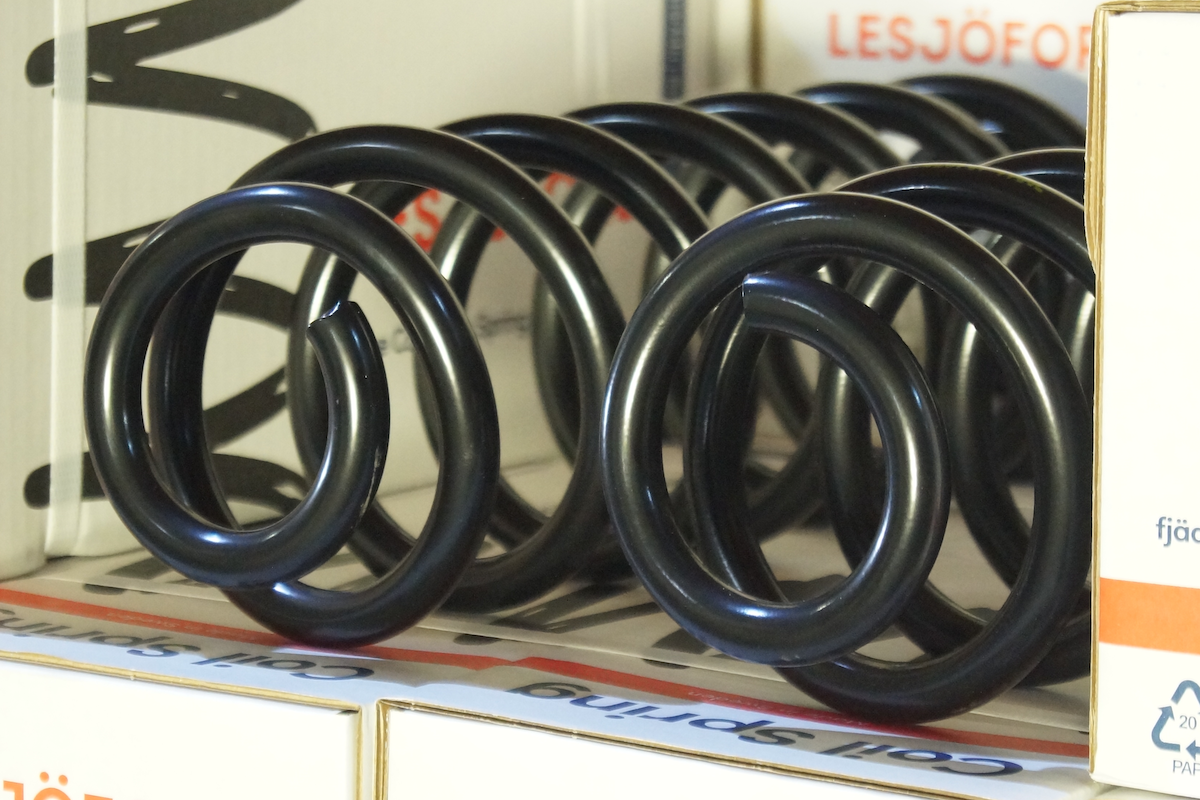
The end of the spring coil should be flat, smooth and painted. Ends that are rusted, slanted or sharp are indications that the spring has broken. As noted above, sometimes only the final coil, or partial coil, breaks off, so the spring may still be in place.
Preventing Broken Springs
The nature of spring design and their use means that breaks are pretty much guaranteed. However, just like most components, keeping corrosion at bay will give you the best shot of prolonging the life of your springs. Frequent undercarriage washes and storing your vehicle covered when possible are both things you can do to slow corrosion.
Buying the right replacement springs is important too, as not all springs are created equal. Choose a spring manufacturer that uses powder coating rather than painting – powder coating is a much more expensive process that results in a hard shell coating rather than a thin layer of paint.