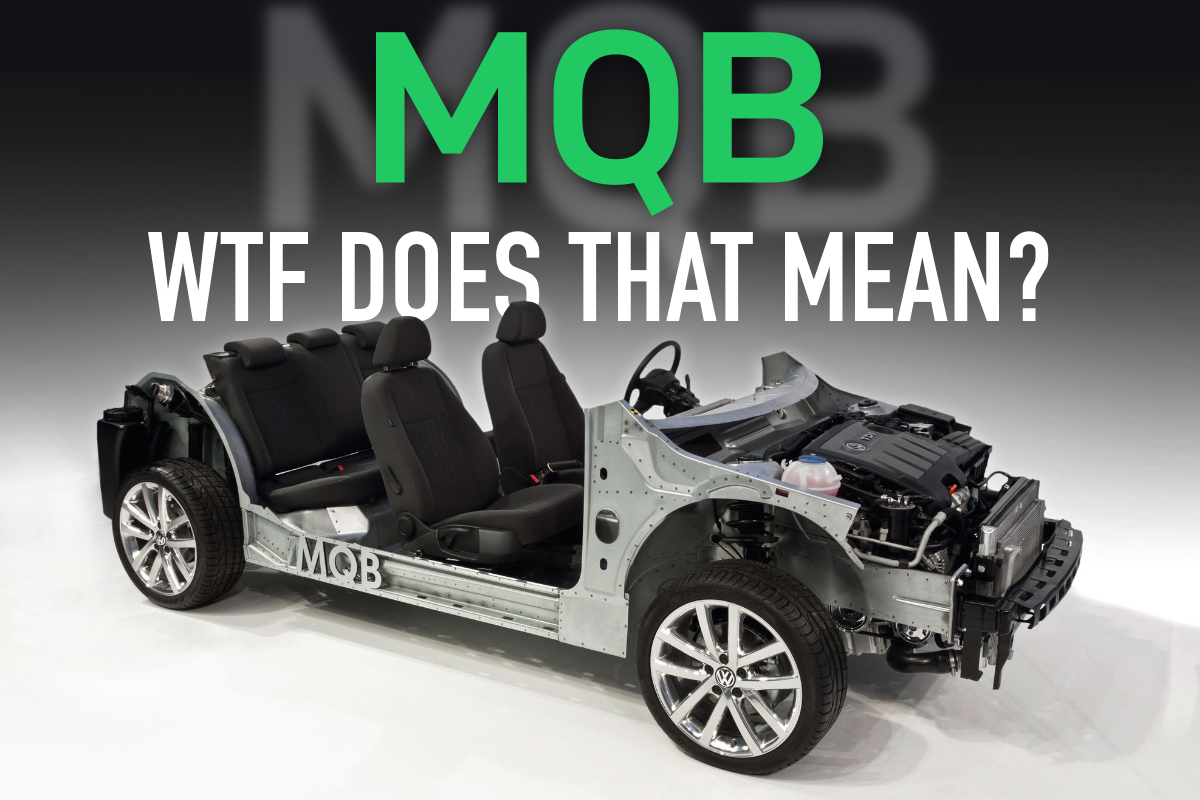
If you’ve looked at a Volkswagen lately and thought, “Wait… why does everything look kinda the same?” congratulations, you’ve met MQB, Volkswagen’s favorite three-letter acronym (after “TDI,” obviously). As we have been getting more into the gasoline VWs we keep coming across the term MQB. But WTF is MQB?

MQB stands for Modularer Querbaukasten, which is German for “Modular Transverse Matrix.” Sounds fancy! In simpler words, it’s VW’s one-size-fits-most car platform, a shared foundation that underpins everything VW Group makes, from the Golf to the Atlas Cross Sport to the Audi A3 and even some SEATs and Škodas you forgot existed.
Think of MQB as the automotive version of IKEA furniture. Different shapes, same Allen wrench.

The Birth of MQB: One Platform to Rule Them All
Back in the early 2010s, VW had a revelation:
“Hey, instead of building a unique platform for every car, what if we built one and just stretched or squished it depending on what badge we slap on it?”
Genius!
With MQB, VW standardized where the engine sits, how the suspension mounts, and how the electronics connect. Building a new car was more like playing with Legos and less like reinventing the wheel each time.
Want a hatchback? MQB.
Want a crossover? MQB.
Want a sporty sedan? MQB.
Want a burrito? Well… not so much.
It’s Not Just VW Being Lazy (Mostly)
You might think this is a “cut corners and save money” move — and yes, somewhat. But MQB actually makes engineering and manufacturing far more efficient.
- Parts can be shared across models.
- Production lines can switch between models faster.
- Engineers can focus on refinement instead of redoing the same work for each car.
It’s like VW built a giant car recipe; same base ingredients, different toppings.

So What’s Actually Built with MQB?
Just about everything:
VW: Golf Mk7 and Mk8, Jetta, Passat (EU/China), Arteon, Tiguan, Taos, Atlas Cross Sport
Audi: A3, TT, Q2, Q3
Škoda: Octavia, Karoq, Kodiaq
SEAT: Leon, Ateca, Tarraco
Basically, if it’s a modern VW Group car with a transversely mounted engine, it’s part of the MQB family
MQB Evo: Now With Added Acronym!
Because you can’t just stop at modularity, VW came out with MQB Evo, which powers the latest-generation Golf, Audi A3, and more. Evo adds updated electronics, improved safety, and new hybrid options.
Translation: MQB went to the gym and downloaded a few software updates.
So, MQB WTF?
At first glance, it feels like VW got lazy: “Oh look, another MQB car.” But really, MQB is VW’s way of quietly building a global empire of cars that feel familiar, drive similarly, and can share everything from infotainment systems to windshield wipers.
Sure, it’s a little spooky that your Golf and your parents’ Tiguan are basically twins, but hey, at least the parts warehouse guy finally has an easy job. And it makes it easier to source the parts that you need.
Final Thoughts
The MQB platform might sound boring, but it’s the backbone of almost everything VW builds now. It’s modular, efficient, and just German enough to make you feel like there’s a secret spreadsheet somewhere in Wolfsburg that dictates every bolt torque in the Group.
So next time someone asks what platform your VW is on, just smile and say:
“MQB. WTF else?”